

Built to Last? Why My 1775 Farmhouse Still Stands Strong Without Rebar or Ties
By Robert Smith Founder, Fresh Start Designs
I currently live in a home in Phoenixville, Pennsylvania, that was built in 1775. That is one year before the Declaration of Independence was signed.
When I walk down to my basement, I don’t see poured concrete walls reinforced with steel rebar. I don’t see Simpson Strong-Tie straps holding the floor joists to the foundation. I see stones—massive, irregular stones that were likely pulled from the ground right here on this property or hauled up from the nearby Schuylkill River.
In my line of work as a Residential Designer, I spend my days navigating modern building codes. I design homes that require specific hold-downs, hurricane straps, engineered lumber, and shear walls. It begs a fascinating question that I often discuss with my clients:
Why is my 250-year-old home still standing without any of that modern structural engineering?
Are we over-engineering our homes today? Or has the quality of our materials degraded so much that we need all this hardware just to keep a house upright?
The answer lies in a tug-of-war between quality of materials and precision of design.
The Lumber Factor: Old Growth vs. New Growth
If you cut into a stud inside the walls of my 1775 farmhouse, you will hit wood so hard it can bend a nail.
The pioneers who built homes in Chester County centuries ago were harvesting old-growth timber. These were trees that had grown slowly in dense, virgin forests over hundreds of years. Because they fought for sunlight, they grew slowly, resulting in growth rings that are incredibly tight and close together.
Old Growth (Then): High density, natural resistance to rot and termites, and incredibly stable. It doesn't warp or twist easily.
New Growth (Now): Today’s lumber is farmed. It is "fast-growth" pine, harvested in 10–20 years. The rings are far apart, the wood is softer, and it is prone to twisting and shrinking.
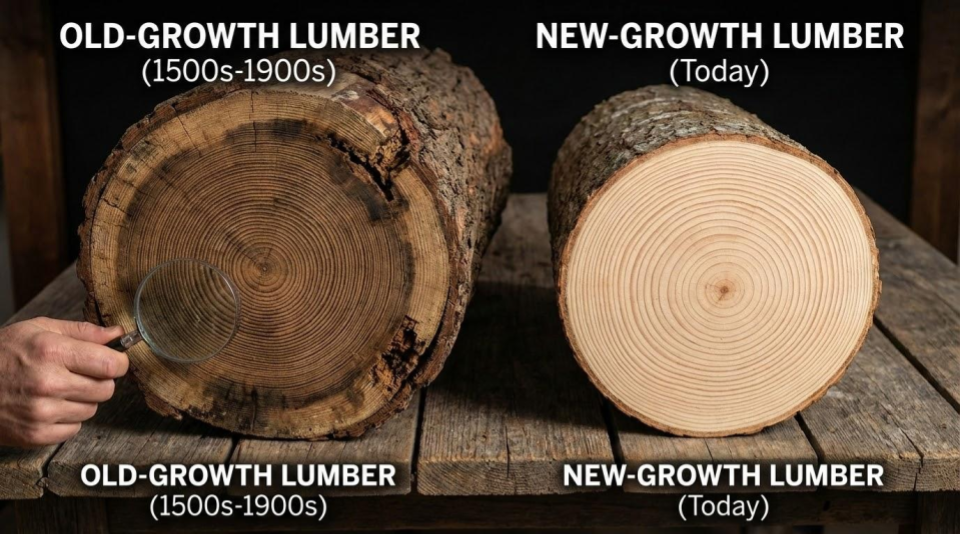
The Verdict: We aren't just "over-engineering" for fun. We have to engineer modern homes to compensate for the fact that today's wood is structurally inferior to the wood used 200 years ago. We use double top plates, headers, and metal connectors because the wood itself can no longer do the heavy lifting alone.
Gravity vs. Tension: The "Heavy" Advantage
My 1775 home was built using Timber Framing and masonry. It is undeniably heavy. The structural strategy of the 18th century was simple: Mass and Gravity.
The sheer weight of the slate roof, the massive oak beams, and the stone walls keeps the house pinned to the ground. It doesn't need "tie-downs" because the wind would have to be catastrophic to lift a structure that heavy.
Modern homes are built with "stick framing" (2x4s and 2x6s). They are lightweight and efficient. However, because they are light, they act like kites in high winds or seismic events.
The Modern Solution: We use Simpson straps and tie-downs to create a "continuous load path." These metal connectors mechanically tie the roof to the walls, and the walls to the foundation, ensuring the house doesn't blow apart.
My old house relies on its weight to stand still. Your new house relies on tension and steel connections.
The Myth of Survivorship Bias
It is easy to look at my house and say, "They don't build them like they used to!" But there is a catch: Survivorship Bias.
We only see the old homes that were built well enough to survive. We don't see the thousands of shoddily built shacks, barns, and hasty structures from the 1700s that collapsed, rotted, or burned down 150 years ago.
The homes that remain in Chester County today are the "champions" of their era—the ones built by the wealthiest families or the most skilled master craftsmen using the best stones and the straightest trees.
Are We Over-Engineering?
In my opinion? No.
While it might feel frustrating to pay for structural engineering, rebar, and metal straps, we are building for predictability and safety.
Foundations: My stone foundation is charming, but it leaks, and it shifts with the freeze/thaw cycle. A modern reinforced concrete foundation is chemically engineered to stay rigid and dry.
Safety: If a massive hurricane hits, my 1775 house relies on luck and gravity. A modern engineered home has a calculated probability of survival.
The "Fresh Start" Approach
At Fresh Start Designs, we love the character of the old. There is nothing like the soul of a home built by hand with materials from the earth. But we also respect the science of the new.
When we design an addition for a historic farmhouse or a brand-new custom home, we blend these philosophies. We aim for the aesthetic timelessness of the past—using quality materials, stone, and heavy timbers where visible—backed by the invisible safety net of modern structural engineering.
We don't want to build homes that just stand for now. We want to design homes that will be the "historic masterpieces" of the year 2225.
Ready to revive your home?
Whether you live in a historic gem in Phoenixville or are looking to build a new legacy in the Philadelphia suburbs, let's design it right.

Robert Smith
FRESH START DESIGNS
Founder | Owner | Residential Designer
Fresh Start Designs 📍 Phoenixville, PA
📞 610-624-2164