

Avoiding Remodel Sticker Shock: A Homeowner’s Guide
By Robert Smith Founder, Owner, and Residential Designer Fresh Start Designs
If you are reading this, you are likely standing in your kitchen, looking at a wall you want to remove, or standing in your backyard envisioning a new addition. You have a vision. But between that vision and the finished reality lies a terrifying chasm known as "The Budget."
As the founder of Fresh Start Designs here in Pennsylvania, I sit across from homeowners every week who have done their homework. They’ve watched the renovation shows. They’ve scrolled through Pinterest. They have a number in their head. And often, when we start doing the real math, that number is 30% to 50% lower than reality.
This is called "sticker shock." It happens not because homeowners are naive, but because the construction industry is complex. A renovation isn’t just buying lumber and paying a guy to hammer it. It is a symphony of fees, regulations, and moving parts.
Here is the truth about what a remodel actually costs—and how you can plan for it without losing your mind (or your savings).
The Invisible Costs: It’s Not Just Materials and Labor
When you imagine a $100,000 budget, you likely imagine $100,000 worth of cabinets, flooring, and tile. In reality, a significant chunk of that money is spent before a single hammer swings.
1. The Design & Professional Team
You cannot build what you cannot define. Whether you are doing a complex interior remodel or a major addition, you need a plan.
Residential Designer/Architect Fees: To translate your dream into a buildable set of plans, expect to allocate 5% to 15% of your construction budget. At Fresh Start Designs, we focus on detailed construction drawings that reduce confusion later.
Structural Engineer: If we are removing a load-bearing wall to open up that kitchen, or digging a new foundation, we need a structural engineer to stamp the plans. In Pennsylvania, this is non-negotiable for permit approval. Cost: typically $500 - $5,000 depending on complexity.
Civil Engineer: This is the one that catches people off guard. If you are adding an addition, extending a driveway, or changing the grading of your lot, you may need a civil engineer for a grading plan or stormwater management (more on that below). Cost: $2,500 - $5,000+ if full site engineering is required.
2. The "Permission" Costs (Permits & Codes)
You have to pay for the privilege of improving your own home. In Pennsylvania—whether you're in Phoenixville, West Chester, or Downingtown—the townships are vigilant.
Building Permits: These are not a flat $50 fee. They are usually calculated as a percentage of the total construction cost or on a square-foot basis. For a decent-sized addition, permit fees alone can run $1,000 to $3,000.
Zoning Permits: Needed if you are changing the footprint of the house (additions, decks).
Code Restrictions: We design to the International Residential Code (IRC). Sometimes, touching one part of a house triggers a requirement to bring other parts up to code (e.g., hardwired smoke detectors throughout the house, egress windows in basements, or updating electrical panels).
3. The "Dirt" Logistics (Additions Only)
If you are building out, you are dealing with land regulations.
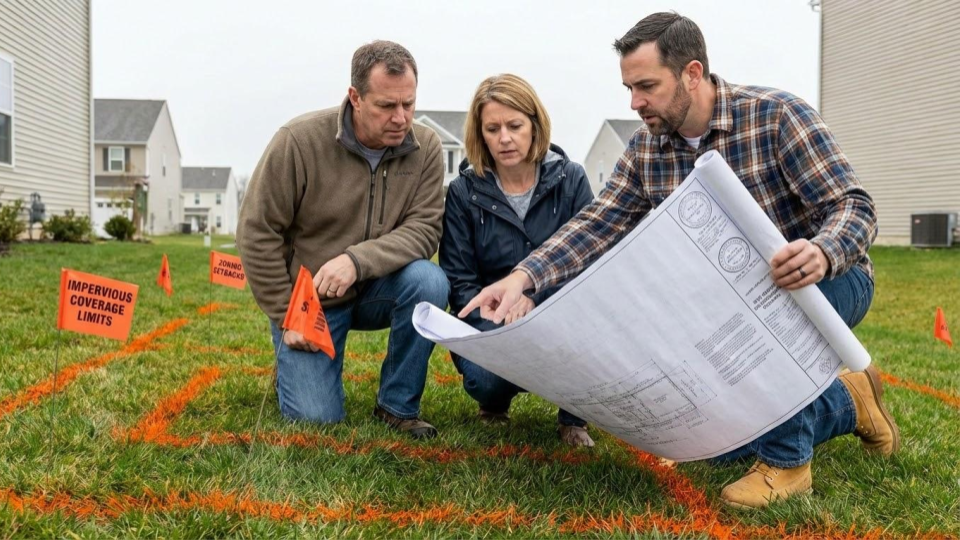
Impervious Coverage: Most lots in our area have a limit on "impervious coverage" (surfaces water can't soak into, like roofs and driveways). If your zone allows 35% coverage and you are already at 34%, you cannot build that addition without a variance (expensive legal process) or an engineered stormwater system.
Setbacks: You cannot build right up to your property line. If your side-yard setback is 15 feet, your addition must stop 15 feet from the neighbor's line. We have to design strictly within this invisible box.
Stormwater Management: In PA, if your new roof and patio add more than a certain square footage of impervious surface (often as low as 500 or 1,000 sq. ft. in some townships), you must install a seepage pit or rain garden to manage runoff. This can easily add $5,000 - $15,000 to your project underground, where you’ll never see it.
The General Contractor’s Equation
Once the paperwork is done, you hire the General Contractor (GC). Here is where the math gets tricky for homeowners.
The Markup: A GC manages the chaos. They carry the insurance, the risk, and the schedule. For this, they charge a markup on everything—labor and materials. This is typically 20% to 30%.
Example: If you pick out $10,000 worth of tile, the GC might charge you $12,000 or $13,000. Why? Because if that tile arrives broken, they handle the return. If they are short two boxes, they drive to get more. That markup covers their logistics and liability.
Change Orders: The silent budget killer. A change order happens when you change your mind ("Actually, let's move that window") or we find a surprise (termite damage behind the wall). Change orders often come with a higher markup because they disrupt the workflow.
How to Educate Yourself and Plan
The goal isn't to scare you; it's to empower you. Sticker shock vanishes when you replace assumptions with data.
Stop Trusting TV Budgets: HGTV shows are often filmed in lower-cost areas, use free labor/materials for product placement, and rarely include contractor fees or permit costs.
Build a "Project Cost" vs. "Construction Cost" Budget:
Construction Cost: What you pay the builder (Materials + Labor).
Project Cost: Construction Cost + Design Fees + Engineering + Permits + Contingency.
Rule of Thumb: If you have $150k to spend, your construction contract should be around $120k. The rest is for the "soft costs" and the unexpected.
The Contingency Fund: You must set aside 10% to 20% of your budget for "unknowns." If you don't use it, buy new furniture at the end. If you do need it (and you likely will), you won't panic.
Hire a Designer First: A good designer (like us!) helps you value-engineer before you bid. We can tell you, "Moving this toilet five feet will cost you $3,000 in plumbing. Is it worth it?"
Let's Clear the Fog
Renovating should be exciting, not terrifying. The antidote to anxiety is a clear plan and a transparent team.
At Fresh Start Designs, we pride ourselves on being that transparent partner. We help you navigate the fees, the codes, and the design choices so you know exactly where your investment is going.
Ready to see what your project might actually look like (and cost)?

Robert Smith
FRESH START DESIGNS
Founder | Owner | Residential Designer
Phoenixville, PA
Web: www.freshstartdesignsco.com
Phone: 610-624-2164
Email: revive@freshstartdesignsco.com